


What Kiteboard Size Should You Choose Based on Your Weight and Riding Style?
Choosing the right kiteboard size is just as important as choosing the right kite. A board that is too small can reduce planing and control, while a board that is too large may feel uncomfortable and difficult to manage in strong wind.
The good news is that modern kiteboards have a very wide usable range, and for most riders, one properly chosen board is enough for almost every condition.
In this guide we’ll help you choose the ideal board size according to:
- Rider weight
- Riding style
- Skill level
- Typical wind conditions
- Spot characteristics
All references are mainly focused on North Kiteboarding twin tip boards.
What Actually Influences Kiteboard Size?
Rider Weight
This is the most important factor.
The heavier the rider:
- the more surface area is needed
- wider boards become more important
- early planing matters more
Riding Style
Freeride
Focused on comfort, versatility and ease of use.
Usually balanced sizes.
Big Air
Riders often use slightly smaller boards for:
- more control
- stronger edging
- better loading for jumps
- smoother handling in strong wind
Freestyle
Usually compact and stiffer boards.
Focused on:
- explosive pop
- unhooked riding
- precision
Lightwind
Surface area becomes critical.
Boards are:
- longer
- wider
- designed for maximum planing efficiency
Width Is Almost More Important Than Length
Many riders only look at board length:
“I ride a 138”
But width completely changes the feeling.
For example:
- 138x39 → faster and more technical
- 138x42 → much more planing and stability
Width directly affects:
- early planing
- upwind ability
- stability
- low-end performance
- comfort
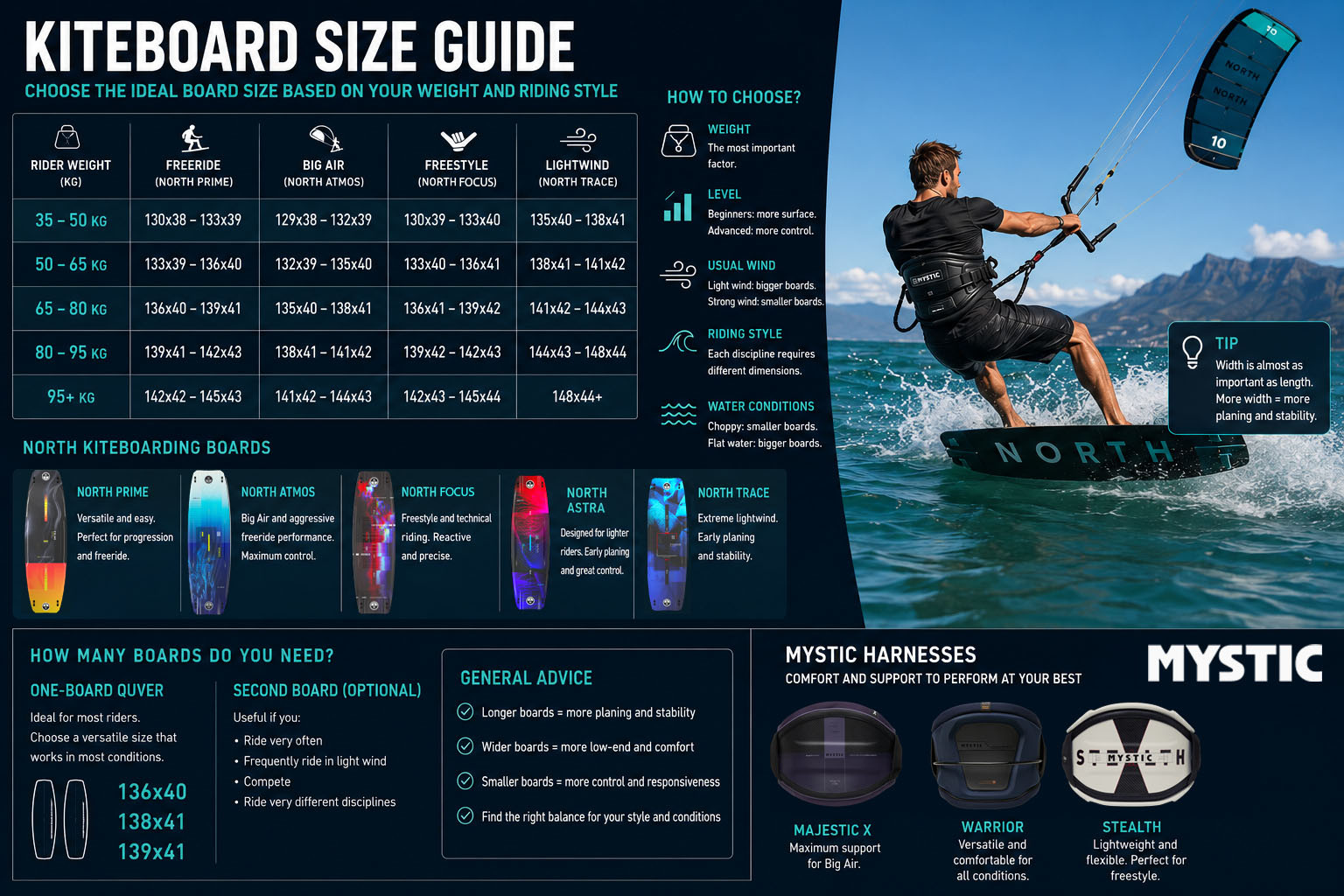
Recommended Kiteboard Sizes by Weight and Riding Style
Riders 35-50 kg
| Style | Recommended Sizes |
|---|---|
| Freeride | 130x38 – 133x39 |
| Big Air | 129x38 – 132x39 |
| Freestyle | 130x39 – 133x40 |
| Lightwind | 135x40 – 138x41 |
Light riders usually feel more comfortable on compact boards.
Too much surface area can make the board harder to control.
Riders 50-65 kg
| Style | Recommended Sizes |
|---|---|
| Freeride | 133x39 – 136x40 |
| Big Air | 132x39 – 135x40 |
| Freestyle | 133x40 – 136x41 |
| Lightwind | 138x41 – 141x42 |
This is one of the most versatile weight ranges.
A board around 135x40 works perfectly in most conditions.
Riders 65-80 kg
| Style | Recommended Sizes |
|---|---|
| Freeride | 136x40 – 139x41 |
| Big Air | 135x40 – 138x41 |
| Freestyle | 136x41 – 139x42 |
| Lightwind | 141x42 – 144x43 |
Probably the most common range.
A 138x41 is one of the most versatile sizes available.
Riders 80-95 kg
| Style | Recommended Sizes |
|---|---|
| Freeride | 139x41 – 142x42 |
| Big Air | 138x41 – 141x42 |
| Freestyle | 139x42 – 142x43 |
| Lightwind | 144x43 – 148x44 |
Board width becomes increasingly important in this category.
Riders 95+ kg
| Style | Recommended Sizes |
|---|---|
| Freeride | 142x42 – 145x43 |
| Big Air | 141x42 – 144x43 |
| Freestyle | 142x43 – 145x44 |
| Lightwind | 148x44+ |
Heavier riders benefit enormously from wider boards.
A board that is too small dramatically reduces low-end performance.
Which North Kiteboarding Board Should You Choose?
North Prime
The most versatile and user-friendly option.
Ideal for:
- progression
- freeride
- riders looking for comfort and ease
North Atmos
A benchmark for aggressive freeride and Big Air.
Perfect for:
- jumping
- speed
- strong edging
- advanced riders
Excellent control in strong wind.
North Focus
Designed for freestyle and technical riding.
More reactive and aggressive.
North Astra
Specifically designed for lighter riders.
Excellent for:
- women
- lighter riders
- younger riders
North Flare
Pure freestyle performance.
Built for:
- wakestyle
- unhooked riding
- maximum stiffness and pop
North Trace
Designed in big surfaces for lightwind rides.
Bigger Is Not Always Better
Many riders think:
“The bigger the board, the better”
But that’s not always true.
A board that is too large:
- bounces more in chop
- becomes harder to edge
- feels less playful
- loses control in strong wind
- can become tiring
That’s why advanced riders often prefer slightly smaller boards.
So… How Many Boards Do You Need?
Most riders only need one main board.
For example:
Ideal One-Board Quiver
- 136x40
- 138x41
- 139x41
Depending on rider weight and style.
Optional Second Board
Only really useful if:
- you ride very often
- you frequently ride in light wind
- you compete
- you practice very different disciplines
Final Advice: Prioritize Control Over Size
A comfortable and controllable board:
- improves technique
- helps progression
- reduces fatigue
- improves landings
- makes sessions more enjoyable
The biggest board is not always the best choice.
Conclusion
Choosing the right kiteboard size is all about balancing:
- rider weight
- riding style
- typical wind conditions
- skill level
- personal preferences
Modern North Kiteboarding boards have an incredibly wide usable range, and with the right choice, one board can cover almost all your sessions.
At Ridezone, we can help you choose the perfect setup for your local spot and riding style.