


What Kite Size Should You Choose Based on Your Weight and the Wind
Choosing the right kite size is one of the most important decisions in kitesurfing. It directly affects not only performance, but also safety, control and rider progression.
One of the most common mistakes beginners make is thinking they need a huge number of kites to cover every condition. The reality is that, thanks to the massive wind range of modern North Kiteboarding kites, most riders can perfectly cover almost all conditions with a 2 or 3 kite quiver.
In this guide we’re going to simplify things properly.
But we’re also going to keep it realistic.
This is not a conservative “school-style” chart. It’s a practical reference based on:
- real freeride and Big Air usage
- actual behaviour of each North model
- intermediate and advanced riders
- real-world riding conditions
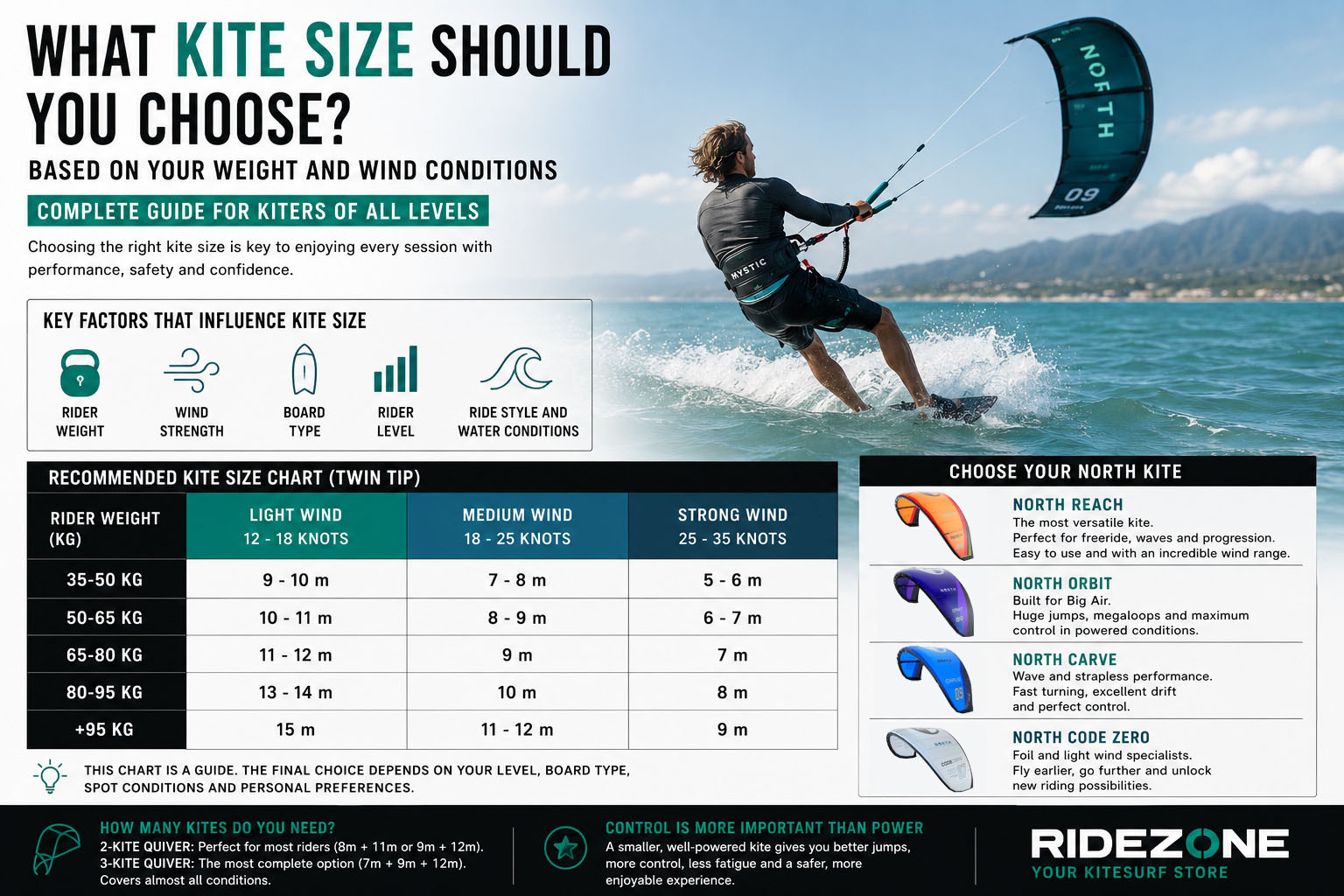
What Influences the Ideal Kite Size?
Before checking the charts, it’s important to understand what affects kite size choice:
- Rider weight
- Wind strength
- Board type
- Skill level
- Riding discipline
- Sea state
- Currents and tides
- Gusty or steady wind
These recommendations are mainly intended for:
- Twin tip riding
- Freeride / Big Air
- Intermediate riders
Advanced riders usually ride smaller kites than beginners.
Realistic Kite Size Chart by Rider Weight and Wind
Riders from 35–50 kg
| Wind | Recommended Size |
|---|---|
| 8–12 knots | 12m–15m |
| 12–18 knots | 9m–10m |
| 18–25 knots | 7m–8m |
| 25–35 knots | 5m–6m |
| 35–45+ knots | 4m–5m |
Light riders benefit massively from smaller kite sizes. A North Orbit 5m or Reach 5m offers incredible control in strong wind.
Riders from 50–65 kg
| Wind | Recommended Size |
|---|---|
| 8–12 knots | 13m–17m |
| 12–18 knots | 10m–11m |
| 18–25 knots | 8m–9m |
| 25–35 knots | 6m–7m |
| 35–45+ knots | 5m |
This weight range is very common among junior riders and many women.
Riders from 65–80 kg
| Wind | Recommended Size |
|---|---|
| 8–12 knots | 15m–19m |
| 12–18 knots | 11m–13m |
| 18–25 knots | 9m–10m |
| 25–35 knots | 7m–8m |
| 35–45+ knots | 5m–6m |
Probably the most common rider range. A 7m + 9m + 12m quiver covers almost every typical condition.
Riders from 80–95 kg
| Wind | Recommended Size |
|---|---|
| 8–12 knots | 17m–19m |
| 12–18 knots | 13m–15m |
| 18–25 knots | 10m |
| 25–35 knots | 8m |
| 35–45+ knots | 6m–7m |
Heavier riders usually need slightly more surface area to maintain power in medium wind.
Riders over 95 kg
| Wind | Recommended Size |
|---|---|
| 8–12 knots | 19m |
| 12–18 knots | 15m–17m |
| 18–25 knots | 11m–12m |
| 25–35 knots | 9m |
| 35–45+ knots | 7m |
Larger boards also make a huge difference for maximizing light wind performance.
Which North Kite Should You Choose?
North Kiteboarding has one of the most complete and best differentiated kite ranges on the market.
Each model is designed for a very specific riding style.
North Reach
The most versatile kite in the entire range.
Ideal for:
- freeride
- progression
- waves
- jumping
- riders wanting one kite for everything
The Reach stands out for:
- massive wind range
- easy handling
- strong low-end
- easy relaunch
- predictable behaviour
It is probably the best option for most riders.
North Reach Wind Range
| Reach Size | Approximate Wind Range |
|---|---|
| 5m | 28–40+ knots |
| 6m | 24–38 knots |
| 7m | 21–34 knots |
| 8m | 18–32 knots |
| 9m | 16–30 knots |
| 10m | 14–28 knots |
| 11m | 13–26 knots |
| 12m | 11–24 knots |
| 13m | 10–22 knots |
| 15m | 8–18 knots |
| 17m | 7–16 knots |
| 19m | 6–14 knots |
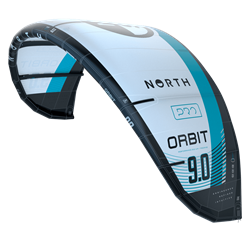
North Orbit
The global benchmark for Big Air.
Designed for:
- huge jumps
- megaloops
- strong wind
- advanced riders
- competition
The Orbit delivers:
- incredible gust control
- huge stability
- massive hangtime
- precise loops
- the ability to ride extremely powered
Many advanced riders use smaller Orbit sizes compared to freeride kites.
Official North Orbit Wind Range
| Orbit Size | Approximate Wind Range |
|---|---|
| 4m | 30–45+ knots |
| 5m | 23–40+ knots |
| 6m | 21–38 knots |
| 7m | 19–36 knots |
| 8m | 17–35 knots |
| 9m | 15–32 knots |
| 10m | 13–29 knots |
| 11m | 12–27 knots |
| 12m | 10–25 knots |
| 14m | 8–22 knots |
An Orbit 5m can easily be ridden above 45 knots in experienced hands.
North Carve
Specialized for:
- wave riding
- strapless
- surfkite
- drift
The Carve turns extremely fast and is usually ridden slightly smaller than a Reach.
North Carve Wind Range
| Carve Size | Approximate Wind Range |
|---|---|
| 5m | 28–40+ knots |
| 6m | 24–36 knots |
| 7m | 21–33 knots |
| 8m | 18–30 knots |
| 9m | 16–28 knots |
| 10m | 14–25 knots |
| 11m | 12–23 knots |
North Pulse
The Pulse is designed for:
- freestyle
- wakestyle
- unhooked riding
- technical riders
Unlike the Orbit or Reach:
- it performs best when powered
- it prefers more line tension
- it generates explosive pop
It’s a more technical and demanding kite.
North Pulse Wind Range
| Pulse Size | Approximate Wind Range |
|---|---|
| 5m | 27–40+ knots |
| 6m | 23–36 knots |
| 7m | 20–33 knots |
| 8m | 18–30 knots |
| 9m | 16–27 knots |
| 10m | 14–25 knots |
| 11m | 12–23 knots |
| 12m | 10–21 knots |
Freestyle riders usually ride much more powered than freeride riders.
North Code Zero
Designed for:
- hydrofoil
- marginal wind
- efficient riding
- extreme light wind
The Code Zero completely changes the rules for minimum wind riding.
With foil boards, riders can use much smaller kite sizes than with twin tips.
North Code Zero Wind Range
| Code Zero Size | Approximate Wind Range |
|---|---|
| 5m | 18–35 knots |
| 6m | 15–30 knots |
| 7m | 12–28 knots |
| 8m | 10–24 knots |
| 9m | 9–22 knots |
| 10m | 8–20 knots |
| 11m | 7–18 knots |
| 13m | 5–15 knots |
So… How Many Kites Do You Really Need?
Ideal 2-Kite Quiver
Perfect for most riders:
- 8m + 11m
or - 9m + 12m
This setup typically covers:
- roughly 15 to 35 knots
- most common riding spots
Ideal 3-Kite Quiver
The most balanced option:
- 7m + 9m + 12m
or - 8m + 10m + 13m
This covers almost every freeride and Big Air condition.
Strong Wind Quiver
Very common in extreme wind spots:
- 5m + 7m + 9m
Perfect for:
- Big Air
- storms
- high wind locations
Why Modern Wind Range Matters
Modern North kites have dramatically more wind range than older generation kites.
For example:
- an Orbit 9m can comfortably ride from around 15 to over 30 knots depending on the rider
- a Reach 12m can perfectly cover sessions from 11 to 24 knots
- a Code Zero 13m allows riding in conditions where many riders are still waiting on the beach
That’s why nowadays it rarely makes sense to own 5 or 6 kites unless you compete or ride almost every single day.
Final Advice: Control Is More Important Than Power
Advanced riders usually ride smaller kites than most people expect.
Why?
Because a controllable kite:
- jumps better
- loops better
- creates less fatigue
- increases safety
- makes every session more fun
Being overpowered rarely means riding better.
Conclusion
Choosing the correct kite size is not about finding an exact size for every single knot of wind.
What really matters is understanding:
- your weight
- your level
- your riding style
- the real behaviour of each kite
- the typical conditions at your local spot
With a well-planned 2 or 3 kite North Kiteboarding quiver, you can cover almost every condition and enjoy every session much more.
At Ridezone we can help you choose the perfect combination for your spot and riding style.